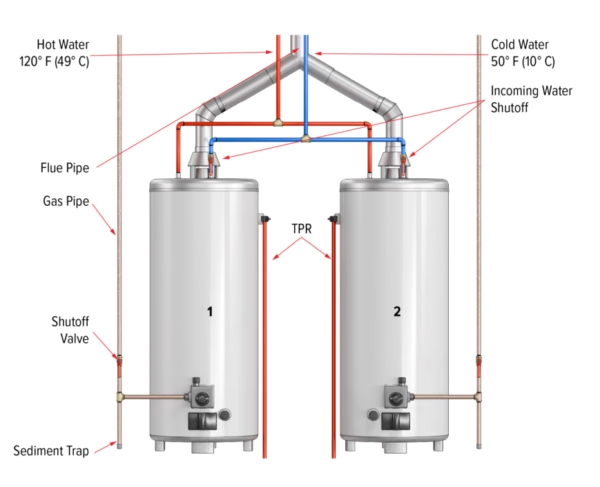
This common but incorrect parallel method of adding a second water heater will result in unbalanced flow and stagnation in tank 2.
This may be the wrong way called “Parallel”
One of the first things done by the average homeowner who is running out of hot water is to turn up the thermostat on the storage tank. This actually makes some sense because less hot water is required to achieve the same mixed temperature ratio. Raising the storage temperature from 120°F to 140°F will increase energy costs for a standard water heater will be fractional. However, if the problem is really one of insufficient volume, the only practical solution is to install a bigger water heater or no tank at all and install a high demand tankless water heater yet at a higher cost. But a tankless water heater will have a pay back period as it’s not heating unused stored water. Thus saving on fuel or electric cost over time.
Adding a new bedroom and or bath, or a jetted tub, or a multiheaded “spa” shower are all good reasons to increase a home’s existing hot-water supply. One solution is to install a separate, dedicated water heater to handle the new outlet. But depending on the extent of the re-routed distribution lines, installation of a separate stand-alone water heater can cost at least $900. Swapping out the too-small heater for a larger unit is another alternative, but the drawback is that the cost of the tank and its installation can easily exceed $1,500. Provided that the existing water heater is relatively new and functions properly, we often recommend adding a second heater and coupling the two to double the supply capacity. This solution averages $700, a substantial savings over the cost of a stand-alone installation.
Twin Tanks (Two Methods)
Once it’s determined that adding a second tank makes sense, there are two basic piping methods that work well: reverse-return and series. Each offers independent operation if one water heater fails or needs servicing. Other incorrect piping methods commonly but erroneously used to add a tank not only perform poorly but may also cause stagnation and ensuing water-quality problems.
Parallel also known as Reverse-return. Reverse-return piping ensures equal draw from two tanks of equal size and capacity. Balanced flow is assured by virtue of the fact that the incoming water’s shortest path is the first tank, while the hot water’s shortest path is from the second tank, which results in both tanks seeing an equal flow.
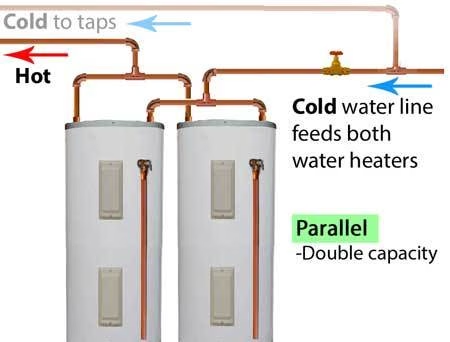
- Parallel (Including Reverse-Return)
- How it works: Cold water splits to feed both tanks simultaneously, and their hot outlets combine into the main supply line. Standard parallel requires identical pipe lengths and fittings so both tanks draw evenly. Reverse-return is a balanced variation where the first tank to receive cold water is the last to feed hot water into the main line, naturally equalizing flow resistance.
- Best for: High simultaneous hot water demand (such as multiple bathrooms or showers running at once) and equal-sized tanks.
- Pros: Shares the workload evenly for longer tank life, provides a larger simultaneous flow rate, and often allows bypassing one tank for maintenance.
- Cons: Unbalanced piping can cause uneven draw, short-circuiting, or stagnation
Series piping is a must if the tanks aren’t the same size. In most cases, the new tank will be the larger of the two because a 50-gallon tank costs a bit less than 40- and 30-gallon models. However, series piping can have a couple of drawbacks. First, there’s a loss of pressure during full flow because of the longer pathway, since all of the hot water must pass through both tanks and their related piping. Second, the first tank in line will always handle the lion’s share of the heating, resulting in earlier burnout than the downstream tank but saves energy on the 2nd tank if and when it’s not needing to heat the water.
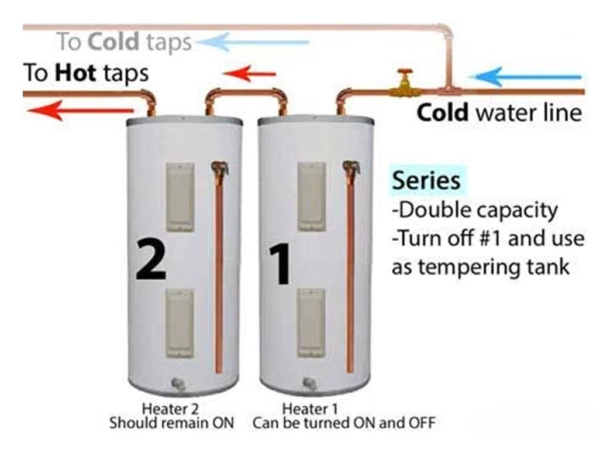
- Series
- How it works: Cold water enters the first tank, exits as preheated water into the cold inlet of the second tank, and then flows from the second tank into the home.
- Best for: Staggered demand or setups using mismatched tank sizes or ages (often placing the newer or preheating unit first).
- Pros: Simple pipe routing without strict length matching, and can work when pairing different tank sizes. First tank saves and works as a preheat as the coldest water enters this first.
- Cons: The first tank does most of the heating work and can wear out faster, and local plumbing codes in some areas restrict or disallow series installations due to stagnation and bacterial concerns.
Most users on Reddit agree that parallel plumbing requires balancing the lengths and fittings of both the cold inlet and hot outlet pipes so each heater draws water equally.
Double-Duty Flue
Water heater life expectancy averages 10 to 15 years. While standard efficiencies hover around 80%, a few gas-fired models offer up to 99% efficiency. The built-in redundancy of a second tank offers the added luxury of never being without hot water, even if one tank fails. And as energy costs rise, the relatively higher price of an ultra-high-efficiency water heater can represent an excellent return on investment.
But remember, a fossil-fuel water heater requires adequate flue-pipe sizing to effectively vent the carbon monoxide produced. If both the new and existing water heaters must share a flue, the flue size must be increased at the junction by at least one pipe diameter. (Refer to manufacturer’s venting requirements and local codes for full compliance.) Generally speaking, the chimney cross-sectional area should be a minimum of 20% larger than the combined cross-sectional area of all appliance flue outlets being served. In an older unlined masonry chimney, a flexible insulated or uninsulated stainless-steel liner (for oil- or gas-fired appliances) or aluminum liner (gas-fired appliances only) should be installed. Flue piping must pitch up from the appliance to the chimney at 1/4 inch per foot and every joint should be securely fastened with a minimum of three stainless-steel self-tapping screws.
Relief Valve Safety
A relief valve that drips whenever the burner runs indicates that the system is subjected to higher-than-normal pressures. Never plug a dripping relief valve. Water under pressure can be superheated well above the boiling point of 212°F. A powerful explosion can result as that superheated water turns to steam and expands some 1,700 times in volume. The T&P (temperature and pressure) relief valve on each tank should be piped full size (typically 3/4 inch) to within 6 inches of the floor and the piping should not be plastic. Plastic piping is not suitable for use with 210°F water because a sudden discharge of 210°F water can cause it to separate or be dislodged, creating a scalding hazard for anyone nearby. T&P valves will discharge under two conditions: if tank pressure reaches 150 psi, or if water temperature reaches 210°F.
Thermal expansion tanks must be taken into consideration whenever you’re installing a hot-water storage tank. Normal water service includes a backflow prevention device or a pressure-reducing valve, which effectively traps water upon entry in the home’s piping system. But as water is heated, its volume increases. A 40-gallon water heater supplied by incoming 38°F water can produce a gallon of thermal expansion, so an adequately sized thermal expansion tank is essential to protect the home’s plumbing from potential damage.
Twinned heaters can be served by a common expansion tank large enough to handle their combined volumes, or each heater can have its own properly sized expansion tank. These must be rated for potable water and a minimum pressure of 150 psi. Note that standard heating system expansion tanks are rated for a maximum of only 30 psi. Be aware also that thermal expansion tank manufacturers may base their sizing requirements on warmer incoming water temperatures and lower finished water temperatures than may be the case, either of which can lead to undersized thermal expansion tanks, a stressed heater, and a dripping relief valve.
A good rule of thumb for sizing thermal expansion tanks is to apply a 1-to-4 ratio in order to minimize pressure spikes. So, if a 40-gallon water heater produces a gallon of thermal expansion, the tank volume should be at least 4 gallons. The majority of potable water thermal expansion tanks are available in a 4.5-gallon volume tank with a factory air-charge of 40 psi. Following installation, that air pressure should be increased to within a few pounds of your incoming municipal or private cold-water pressure.
To contact us and to share a file, use Contact Me. Or upload to a cloud drive and share the link with us or merely email files to us at john@basementdesigner.com.
Need to know more about our services? Click “How It Works” and or “Concept Design Service”
Want to know about other “Basement Topics” listed.